REVIEW · ANTIGUA
Antigua Walking Tour Morning and Afternoon
Book on Viator →Operated by GTM Tour Guide and Travel Services · Bookable on Viator
Antigua clicks into place fast on foot. This guided walk uses the city’s own scars and symbols—especially its earthquake-shaped architecture—to help you read Antigua instead of just passing by it. I love the small group feel and the way the guide turns each stop into a clear story you can remember, plus the strong, friendly guidance that makes the history easy to follow.
The only real drawback is that you’ll want to plan for what’s not included: admissions and basic comfort items like bottled water and coffee/tea. If you’re sensitive to walking (Antigua’s uneven stone streets), bring comfy shoes and pace yourself.
In This Review
- Key highlights before you start
- Why a 3.5-hour Antigua orientation walk fits your time
- Plaza Central Park (Plaza Mayor): where Antigua’s geometry begins
- Catedral de San José: the earthquake story you can actually see
- Museo de Arte Colonial and USAC: art, education, and Spanish-era roots
- Iglesia de San Francisco el Grande: rebuilding in pieces, devotion in place
- Concepción Convent ruins by the Pensativo River: Sister Juana’s world
- Casa Santo Domingo: baroque scale in a former Dominican powerhouse
- Mercado de Artesanías: where the day turns practical
- Price and value: what $27 buys you (and what it doesn’t)
- Comfort, pacing, and small-group reality on Antigua streets
- Who this tour suits best (and who might want something else)
- Should you book this Antigua Walking Tour?
- FAQ
- FAQ
- How long is the Antigua Walking Tour Morning and Afternoon?
- How much does the tour cost?
- Where does the tour start and end?
- What’s included in the price?
- Are admissions included for the churches and museums?
- Is bottled water or coffee included?
- How big are the groups?
- Do I get a confirmation after booking?
- Can I bring a service animal?
- What if the weather is poor?
Key highlights before you start
- A 3.5-hour route that gives real orientation so you know where everything sits in Antigua.
- Churches and convents with earthquake timelines that explain why many buildings look the way they do today.
- Guides like Armando and Moises have been praised for clear English and personable storytelling.
- A mix of grand plazas and quieter ruins so the day doesn’t feel like a nonstop sprint.
- Casa Santo Domingo’s baroque scale shows how big the old convent world was.
- Mercado de Artesanías is a practical landing spot for souvenirs right near the action.
Why a 3.5-hour Antigua orientation walk fits your time
Antigua rewards slow travel, but not everyone has a full day. This tour is built for that middle ground: long enough to hit the key landmarks, short enough that you can still enjoy your afternoon—or go back out on your own with a better sense of direction.
It runs about 3 hours 30 minutes and typically serves groups of up to 15 people. That size matters. You get time to ask questions, but you’re still moving at a pace that keeps the route feeling cohesive. The meeting point is at Café Condesa La Casa del Conde on Avenida Norte 5a, and the walk ends at Mercado de Artesanías on 3a Avenida Nte., about two blocks from the Central Plaza.
You’ll also appreciate the timing flexibility. The tour is available in both the morning and afternoon, so you can choose what matches your energy level and the day’s weather.
You can also read our reviews of more walking tours in Antigua

Plaza Central Park (Plaza Mayor): where Antigua’s geometry begins
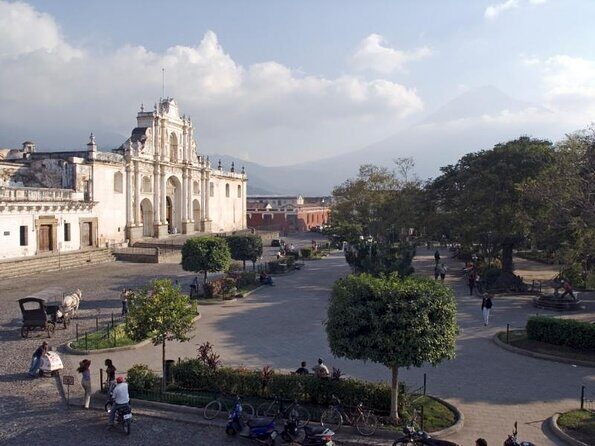
Your first stop is the Plaza Mayor, the starting point for exploring Antigua Guatemala. The city was planned in 1541 with a grid layout—an old-school way to organize power, commerce, and daily life around a central square.
Here’s what I love about starting on the plaza: the details aren’t random. You can literally look at how the city is set up from the center outward. The main square measures 112 meters north to south and 115 meters east to west, and the angles are defined by major architectural landmarks around it.
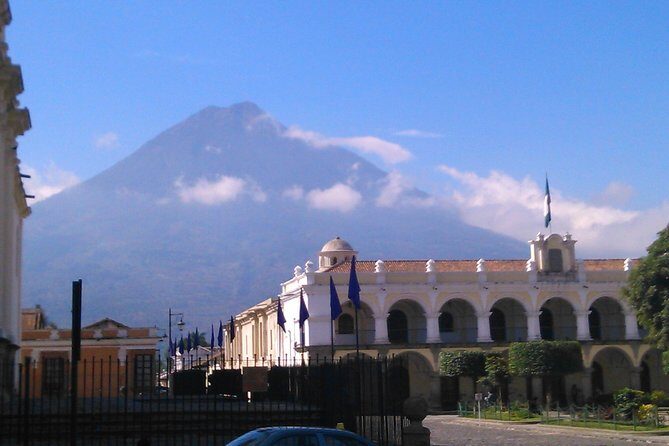
The portal names alone are a clue to how the city worked. To the north you have the portal of Chains and the Palace of the Noble City Hall. To the east sits the Episcopal Palace and the Cathedral of Santiago. The Royal Palace faces the south side, and the west side is linked to the Merchants Portal (often associated with the Panaderas area).
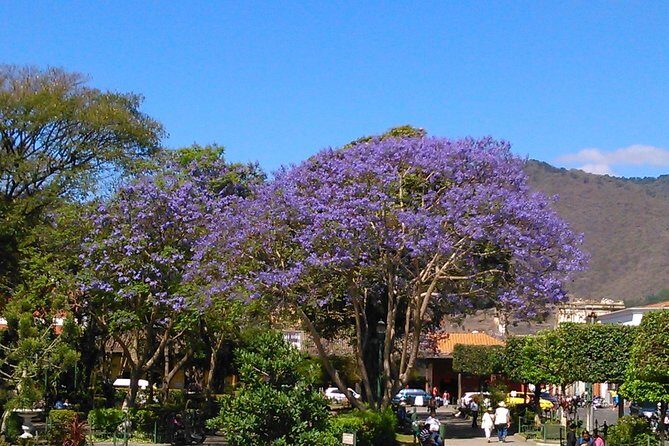
In the middle, don’t skip the Fuente de las Sirenas (built in 1739 by Diego de Porres). It’s a small thing, but it’s the kind of Antigua detail your brain starts to recognize as you walk. Even the trees here tell a story: five Esquisúchil trees planted around 1994 add color and shade while keeping the plaza anchored to modern life.
Practical note: admission isn’t included for this stop, so treat it as a great “look first” stop where the value is in the guide’s explanation and the landmarks you can see around you.
Catedral de San José: the earthquake story you can actually see
Next comes Catedral de San José, located in an area tied to the former Cathedral of Santiago de los Caballeros—a building that suffered heavily during the earthquakes of Santa Marta. That’s why this stop feels different from a normal church visit. The building is less about a single finished moment and more about decades of rebuilding.
The first construction effort began in 1545, using materials carried over from earlier settlement attempts in the Almolonga valley. But frequent earthquakes kept interrupting progress. On April 7, 1669, the temple was demolished, and a second sanctuary was inaugurated in 1680 with direction from Juan Pascual and José de Porres. There’s also evidence that Martín de Andújar Cantos contributed as a Spanish engineer and imager during reconstruction work.
What to pay attention to here: the stop helps you understand why Antigua’s architecture can feel “layered.” It’s not a flaw. It’s the record of survival.
As with the earlier stop, the time is short (about 20 minutes) and admissions aren’t included, so aim to soak up the guide’s context and the overall form you’re seeing rather than expecting a long museum-style visit.
Museo de Arte Colonial and USAC: art, education, and Spanish-era roots
The walk then turns toward cultural institutions with Museo de Arte Colonial and connections to Universidad de San Carlos de Guatemala (USAC). This is a big deal in Guatemala because USAC is the oldest and largest university in the country and the only national university there.
USAC traces its origin to the Spanish colonial period. It was the fourth university founded in America, and for a long time it was the only university in Guatemala—remaining so until 1954.
Even though your time here is brief (about 5 minutes), the value is in the framing. The guide helps you connect colonial art to the institutions that preserved and displayed it. If you’ve ever felt like Antigua is just churches and ruins, this stop nudges you into a more complete picture: Antigua was also an education hub.
This is a quick stop, so if you have strong interest in colonial artwork, you might want to plan extra time nearby after the tour—based on what you see and what the guide points out.
Iglesia de San Francisco el Grande: rebuilding in pieces, devotion in place
One of the most moving stops is Iglesia de San Francisco el Grande. The sanctuary story here spans centuries and several cycles of damage and reconstruction.
The first sanctuary goes back to the mid-16th century, but it deteriorated after a strong earthquake in 1565. The current church was built in 1702 by Diego de Porres, then destroyed by earthquakes in 1717, 1751, and 1773.
Even after that, it wasn’t a straight line. It was abandoned, damaged again by the earthquakes of 1874 and 1917, and only later rebuilt during the second half of the 20th century. A key turning point came in 1967, when regular orders were allowed to have ownership again and the Franciscans returned to the complex.
This stop is especially known for housing the tomb of Pedro de San José de Betancur, a missionary in Guatemala and a saint of Spanish origin. That detail matters. It gives the place more than architectural interest—you get the feeling of a living spiritual history tied to the landscape.
You’ll likely have about 20 minutes here. Admissions aren’t included, so use the time to look carefully at what you can see and let the guide connect the timeline dots.
A few more Antigua tours and experiences worth a look

Concepción Convent ruins by the Pensativo River: Sister Juana’s world
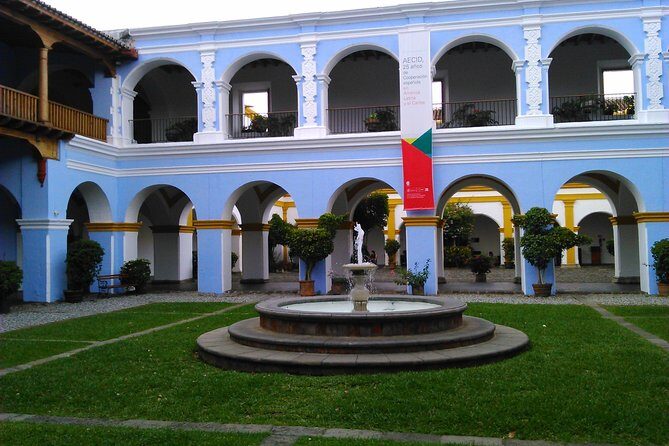
In the middle of the walk, you get a shift in mood with the Concepción Convent ruins. This is a ruined complex, and it’s one of Antigua’s most distinctive sights because it’s tied to a more personal kind of history.
The convent sits on the banks of the Pensativo River. And inside that setting comes one of Antigua’s most intriguing figures: Sister Juana de Maldonado, a poet associated with the convent during the first half of the 17th century. The text around the site notes her as an “urban nun,” which is exactly the kind of phrase that makes you pause and wonder about daily life, discipline, creativity, and reputation all at once.
Even with limited time, I find ruins like this do something churches don’t always do. They help you feel the shape of the past without demanding full attention to interior details. It’s a good moment to slow down, take photos, and reset your brain before the more “grand” spaces later in the route.
Casa Santo Domingo: baroque scale in a former Dominican powerhouse
Then you move into Casa Santo Domingo Museums, connected to the former Convent of Santo Domingo. This is where the tour shows a different side of colonial Antigua—less street-level hardship, more grand institutional power.
Casa Santo Domingo is now a hotel and museum and opened in June 1989. It preserves baroque architecture and displays baroque-era treasures from colonial times. The convent itself was once one of the largest in America, so even if you’ve seen plenty of churches in Antigua, this place changes the scale of what you picture.
Why this stop is so valuable on a walking tour: it bridges the “holy” and the “everyday” worlds of the convent system. You’re seeing architecture meant to hold communities, learning, craft, and devotion under one roof.
The visit time is about 30 minutes. Since admissions aren’t included, I’d treat this as a strong “see-and-listen” stop where the guide helps you understand what you’re looking at, not as a deep dive into every room.
Mercado de Artesanías: where the day turns practical
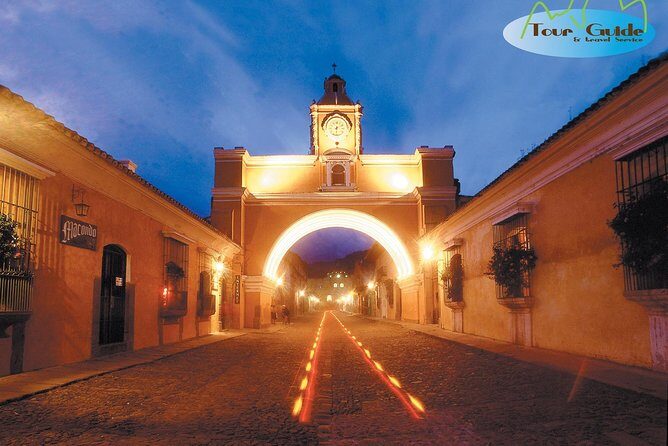
The tour ends at Mercado de Artesanías, and that’s a smart finish. You’ve spent hours learning about churches, convents, and colonial planning—now you get a chance to bring home something tangible.
This is the point where shopping is on your own. The market is also about two blocks from Central Plaza, so after the tour you can easily keep exploring without having to regroup or take extra transport.
Admission is marked as free for this stop, which makes it a low-pressure ending. If you like finding handmade items—ceramics, textiles, small crafts—this is where you’ll have time to compare styles and prices at your own pace.
There’s also a church story braided into this final area. You’ll hear about Iglesia de Nuestra Señora del Carmen, destroyed in the Santa Marta earthquakes of 1773. Even though the temple was almost entirely destroyed, its facade remained and is admired as an example of what’s described as baroque sismic Guatemalan architecture. The description also notes that after 1773, the Carmelite nuns relocated to Guatemala City, and the name Iglesia del Carmen followed.
That makes the market stop feel less random. It’s not just souvenirs; it’s another way Antigua explains itself.
Price and value: what $27 buys you (and what it doesn’t)
At $27 per person, this is solid value for Antigua. You’re paying mainly for a guided route that connects major sights with real historical context—context that would take you a lot longer to assemble on your own.
What’s included is straightforward: a tour guide. What’s not included is also clear: bottled water, coffee and/or tea, and admissions.
So here’s the practical way to think about it: if you’re the type who wants to fully enjoy churches and museums beyond just looking from the outside, you’ll want a bit of extra cash for ticketed entry. If you mainly enjoy the outside architecture and the guide’s explanations, your extra spending can be minimal.
Also remember that the tour is often booked about 10 days in advance. When a walking orientation tour sells out, it’s usually because it’s easier than building your own route from scratch—especially for first-timers.
Comfort, pacing, and small-group reality on Antigua streets
A walking tour sounds simple, but in Antigua, streets matter. Expect plenty of time walking between stops and time standing still for photos and explanations. Since the tour is about 3.5 hours, the pace is best suited for people who are comfortable on cobblestones and uneven sidewalks.
The group size caps at 15. That’s a big plus when you’re trying to hear your guide over city noise. It also means the experience feels more personal, and it’s easier to ask questions without feeling rushed.
Service animals are allowed, and the tour is near public transportation. That’s helpful if you’re moving around the city on your own schedule.
One more consideration: the experience requires good weather. If rain or bad conditions hit, you’ll need to roll with a reschedule option or a refund. Antigua’s charm doesn’t disappear in rain, but slippery streets and visibility can change the experience.
Who this tour suits best (and who might want something else)
This is ideal if you want an Antigua orientation that doesn’t stop at “pretty buildings.” You’ll like it if you enjoy architecture, church history, and the logic behind why so many structures look the way they do after repeated earthquake damage.
It also works well for couples and solo travelers who want structure. With a small group and a clear end point at the crafts market, you’re less likely to waste time guessing where to go next.
If you’re someone who wants very long time inside museums or deep, slow church visits, you may find the route slightly fast. But that’s not a flaw—it’s the tradeoff for getting the big picture in one outing.
Should you book this Antigua Walking Tour?
I’d book it if you’re here for the first time, short on time, or tired of stacking random stops without context. For $27, you get a guided route that helps you understand Antigua’s core story: planned streets, major institutions, and buildings reshaped by earthquakes. The finishing touch at Mercado de Artesanías also means you can translate what you learned into something you can take home.
I’d consider skipping—or pairing it with extra independent time—if you know you want long museum hours and ticketed interiors. In that case, treat this as your orientation chapter, then plan a second visit to the places that grab you most.
FAQ
FAQ
How long is the Antigua Walking Tour Morning and Afternoon?
It’s approximately 3 hours 30 minutes.
How much does the tour cost?
The price is $27.00 per person.
Where does the tour start and end?
It starts at Café Condesa La Casa del Conde, Avenida Norte 5a, Antigua Guatemala, and ends at Mercado de Artesanías on 3a Avenida Nte., Antigua Guatemala.
What’s included in the price?
A tour guide is included.
Are admissions included for the churches and museums?
No. Admissions are not included.
Is bottled water or coffee included?
No. Bottled water and coffee and/or tea are not included.
How big are the groups?
The tour has a maximum of 15 travelers.
Do I get a confirmation after booking?
Yes. Confirmation is received at the time of booking.
Can I bring a service animal?
Yes. Service animals are allowed.
What if the weather is poor?
The tour requires good weather. If it’s canceled due to poor weather, you’ll be offered a different date or a full refund.